
REFLEXOLOGY
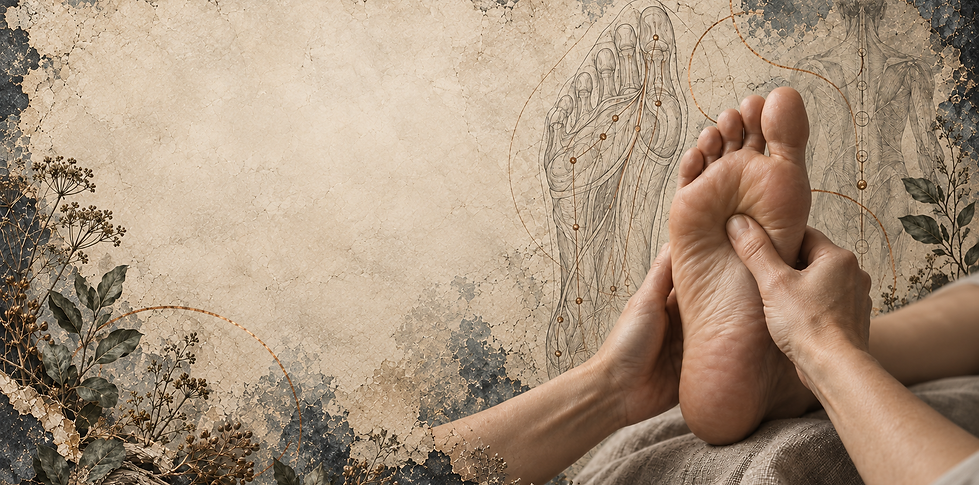
Reflexology is a complementary therapy involving the application of precise pressure to specific points on the feet, hands, or ears. It operates on the principle that these pressure points correspond to different organs, glands, and systems throughout the body.
The session is focused entirely on your feet (and/or hands, ears), but the effects are felt throughout your entire body and system(s)

How It Works
-
Mapping the Body: Practitioners use detailed charts to connect specific areas of the feet, hands, and ears to corresponding organs and body systems.
-
Theories of Healing: Some believe it balances vital energy (or qi), while others suggest the pressure stimulates the central nervous system to reduce stress and encourage relaxation.
-
Difference from Massage: Unlike standard foot massage which targets soft muscle tissues, reflexology specifically focuses on reflex zones and neural pathways to affect systemic body balance.
Potential Benefits
-
Stress and Anxiety: Sessions often lead to deep relaxation and lower anxiety levels.
-
Pain Management: It is sometimes used alongside conventional medical care to help manage symptoms or improve comfort for chronic conditions or palliative care.
-
Safety: Experts consider it safe for most people, though it does not cure or treat specific disease
The session is focused entirely on your feet, hands and/or ears, but the effects are felt throughout your entire system(s)
Reflexology is a complementary therapy involving the application of precise pressure to specific points on the feet, hands, or ears. It operates on the principle that these pressure points correspond to different organs, glands, and systems throughout the body.
While it is widely practiced for stress reduction and deep relaxation, it is considered a complementary or alternative practice rather than a mainstream medical science.
Origin and Historical Evolution
Modern reflexology is unique because it blends ancient Eastern practices with 20th-century Western medical theories.
-
Ancient Roots (Pre-20th Century): Practices resembling reflexology have been traced back thousands of years across multiple cultures.
-
Egypt: A famous wall painting in the tomb of Ankhmahor (the "Physician’s Tomb") dating to roughly 2330 BCE depicts medical practitioners applying pressure to patients' hands and feet.
-
China and India: Early Traditional Chinese Medicine (TCM) incorporated foot and hand therapies alongside acupuncture to stimulate internal energy pathways. Similarly, ancient Indian Ayurvedic medicine utilized pressure on marma points (vital energy spots) to balance bodily health.
-
-
The Birth of modern "Zone Therapy" (1910s): The modern Western framework began with Dr. William H. Fitzgerald, an American ear, nose, and throat specialist. He introduced "Zone Therapy" after discovering that applying pressure to specific zones on the hands and feet could act as an anesthetic and relieve pain in matching vertical zones throughout the body.
-
Mapping the Feet (1930s): A physiotherapist named Eunice Ingham expanded on zone therapy. She discovered that the feet and hands were particularly sensitive and meticulously mapped out the entire body onto the feet. She is widely credited with officially renaming the practice reflexology.
Definitions
The word "reflexology" is defined differently depending on whether it is viewed through a therapeutic or historical medical lens:
-
Therapeutic Definition: The Cochrane Collaboration defines it as the gentle manipulation or pressing on certain parts of the foot to produce an effect elsewhere in the body. Clinically, it is classified as a non-invasive holistic therapy designed to relieve tension and improve blood circulation.
-
Linguistic Origin: The English term emerged in the early 1920s, combining the root word reflex (involuntary reaction or reflection) with the suffix -ology (the study of).
-
Psychological Definition: In older medical dictionaries, the term originally referred to a Russian psychological framework coined by Vladimir Bekhterev in 1917, defined as the objective study of human behavior through automatic nervous reflexes.